BLOGS
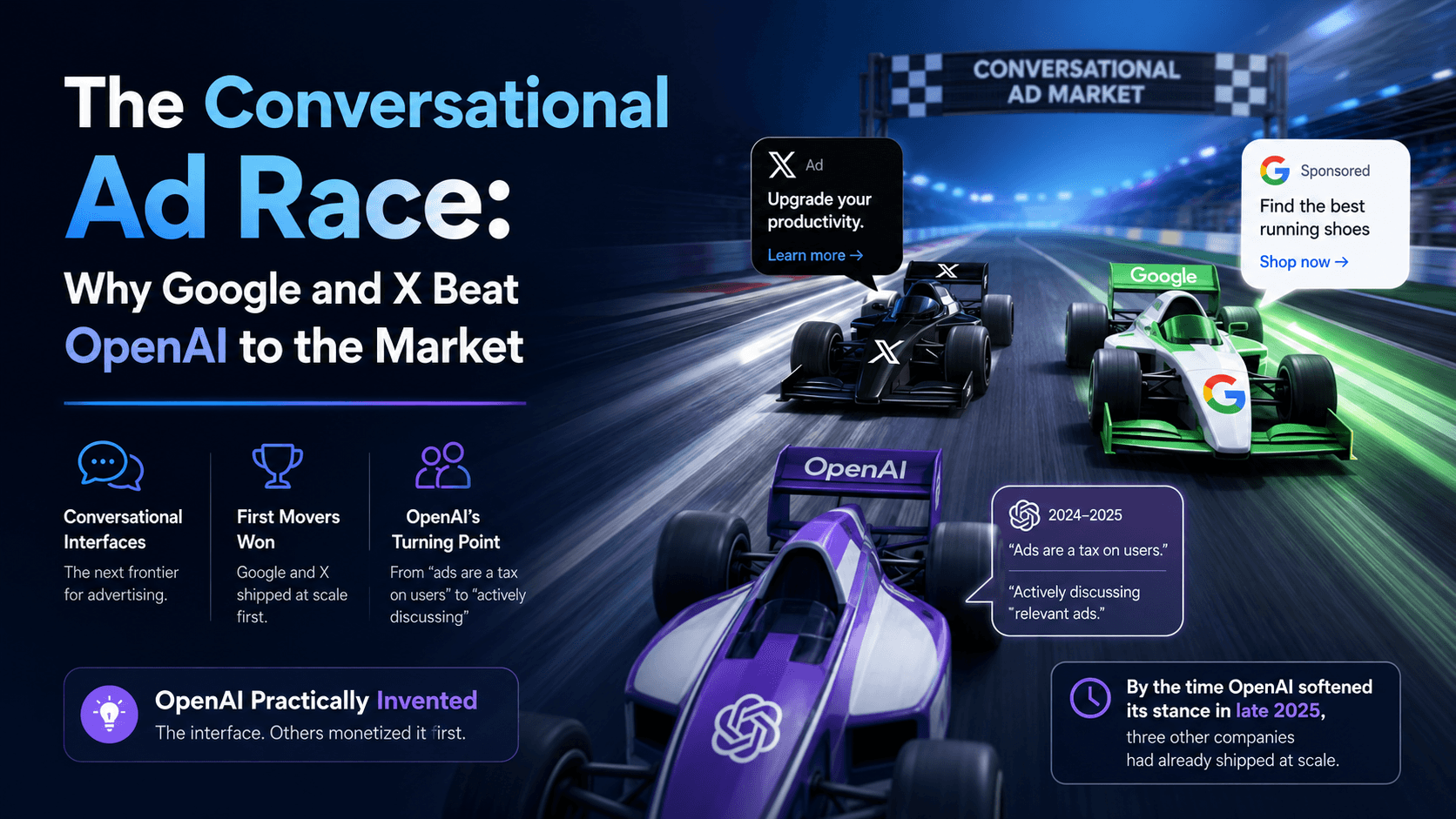
The Conversational Ad Race: Why Google and X Beat OpenAI to the Market OpenAI Practically Invented

Ben Ahn
Linkplus, Director
The Setup: Who Was Supposed to Be First
When ChatGPT crossed mainstream awareness in late 2022 and early 2023, almost every analyst's monetization model for OpenAI included some version of native advertising. The logic was straightforward: a conversational interface that already had hundreds of millions of weekly users represented the most valuable greenfield ad surface since mobile feeds in the early 2010s.
OpenAI's own leadership, however, was the loudest voice against it. CEO Sam Altman in May 2024 called ads "a tax on users" and a "last resort" for the company's business model, framing the subscription-first approach as the company's commitment to keeping answers unbiased. As recently as the 2025 DevDay Q&A, Altman said there were "no current plans" to put ads inside Pulse or ChatGPT, though he acknowledged the company was "actively discussing" Instagram-style relevant ads internally (PC Gamer).
By the time OpenAI publicly softened its stance in late 2025, three other companies had already shipped at scale.
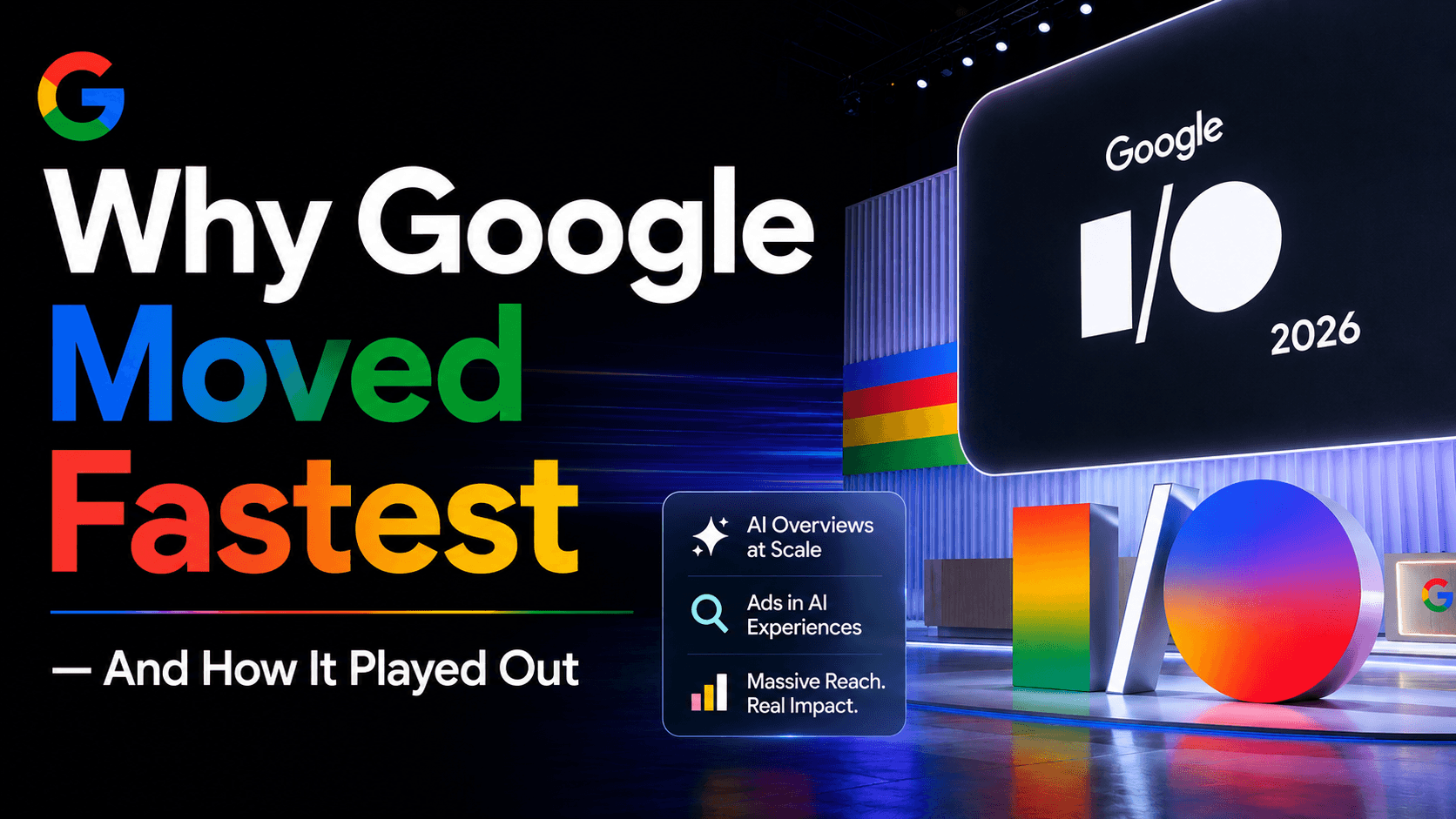
Why Google Moved Fastest — And How It Played Out
Google's structural advantage was simple: it already operated the world's largest ad system, with millions of active advertisers, a mature auction stack, attribution infrastructure, and a sales force that could onboard demand without friction. Plugging a new surface — AI Overviews and AI Mode — into that machine was an extension problem, not a build problem.
The pace reflects that advantage:
AI Overviews coverage rose from 34.5% of Google queries in December 2025 to 48% by March 2026 — a 58% jump in three months.
Ad presence inside AI Overviews went from roughly 5% of AI Overview results in early 2025 to 25.5% in Q1 2026 — a ~394% year-over-year increase.
At Google Marketing Live and I/O 2026, Google introduced four new AI-native ad formats: Conversational Discovery Ads, Highlighted Answers (sponsored entries inside recommendation lists), a Business Agent for Leads (a Gemini chatbot embedded in the ad unit itself), and Direct Offers with native checkout. Pilots with Chewy, Gap, and L'Oréal began in January 2026 (Google Blog) (Search Engine Journal) (Social Media Today).
For marketers, the most consequential change is that AI Mode is now the default Google Search experience, not an opt-in tab. Ads in AI Mode are still in closed trials in the UK as of this writing, but Google has signaled rollout to all advertisers will happen during 2026, with dedicated controls, bidding strategies, and reporting introduced as the surface matures.
The takeaway: Google didn't invent the conversational ad concept. It absorbed it, attached its existing demand engine, and shipped before the conceptual originator could.
X's Parallel Overhaul: Grok-Powered Semantic Targeting
While Google extended its core ads stack, X — in partnership with xAI — chose a more radical path: rebuilding the platform's entire ad infrastructure around contextual and semantic delivery.
The phased rollout began in April 2026 and represents a ground-up redesign of how ads are matched to users. Rather than relying on broad demographic or interest-based targeting, X now uses retrieval and ranking systems powered by Grok to deliver ads aligned with the real-time semantic context of what's happening on the platform — what users are reading, replying to, and engaging with in the moment (LatestLY) (Campaign US).
The new system focuses on three measurable improvements: relevance, engagement, and ROI. Musk has also said Grok-driven brand safety screening has reduced advertiser concerns about placement risk, which was the central blocker for X's reduced advertiser base post-2022. A planned expansion through late 2026 will extend the new AI ad tools to smaller businesses and independent creators (Social Media Today).
Two strategic signals matter here. First, Grok-powered ads are appearing inside Grok answers themselves, not just in the feed — making X the second major platform (after Google) to put paid content directly inside AI responses. Second, X is moving demographic targeting out of the front seat for the first time in the modern social-ad era. If the system delivers on lift, the rest of the industry will face pressure to follow.
Microsoft Copilot: The Quiet Leader in Conversational Ads
Microsoft's positioning in this race is often underestimated, partly because it doesn't generate the same press cycle as Google or X, and partly because it sits on top of OpenAI's technology — making "Microsoft did it first" a complicated headline for both companies.
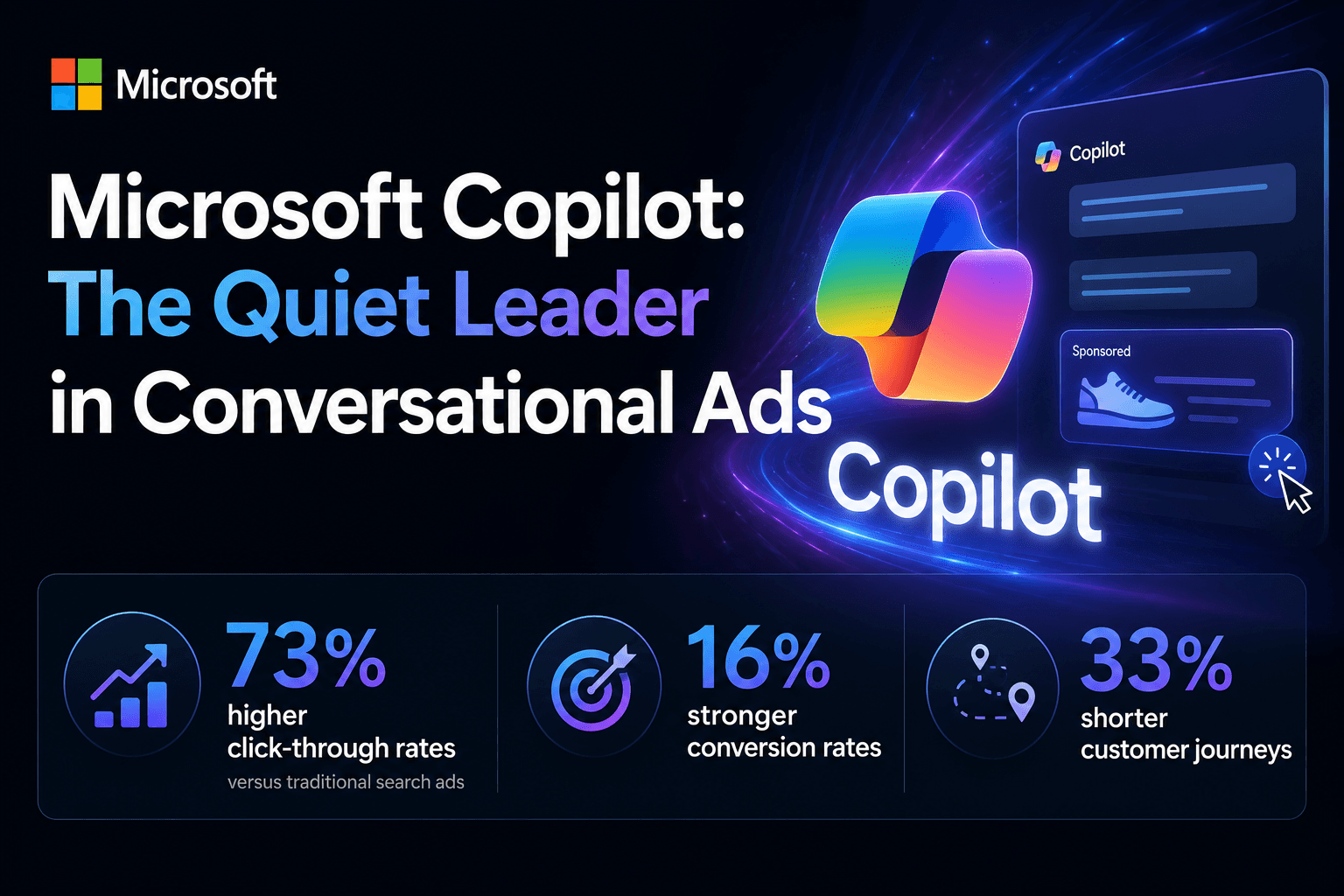
But the numbers are striking. Performance Max campaigns now appear beneath Copilot's AI-generated responses with "Microsoft Advertising" and "Sponsored" labels, and internal Microsoft data from November 2024 to May 2025 reported that Copilot ads generate:
73% higher click-through rates versus traditional search ads
16% stronger conversion rates
33% shorter customer journeys
Microsoft's stated rationale is that conversational placements appear during active research, not before or after it — the highest-intent moment in the buying funnel. On April 21, 2026, Microsoft followed up with a sweeping set of platform updates branded as "Copilot Commerce," organized around a premise the company stated plainly: traditional search rankings no longer determine brand visibility — AI agents do (Marketing Agent Blog).
This positions Microsoft awkwardly relative to its largest AI partner. Microsoft is monetizing the conversational ad surface that uses OpenAI's models — and doing so faster, and at higher unit economics, than OpenAI itself.
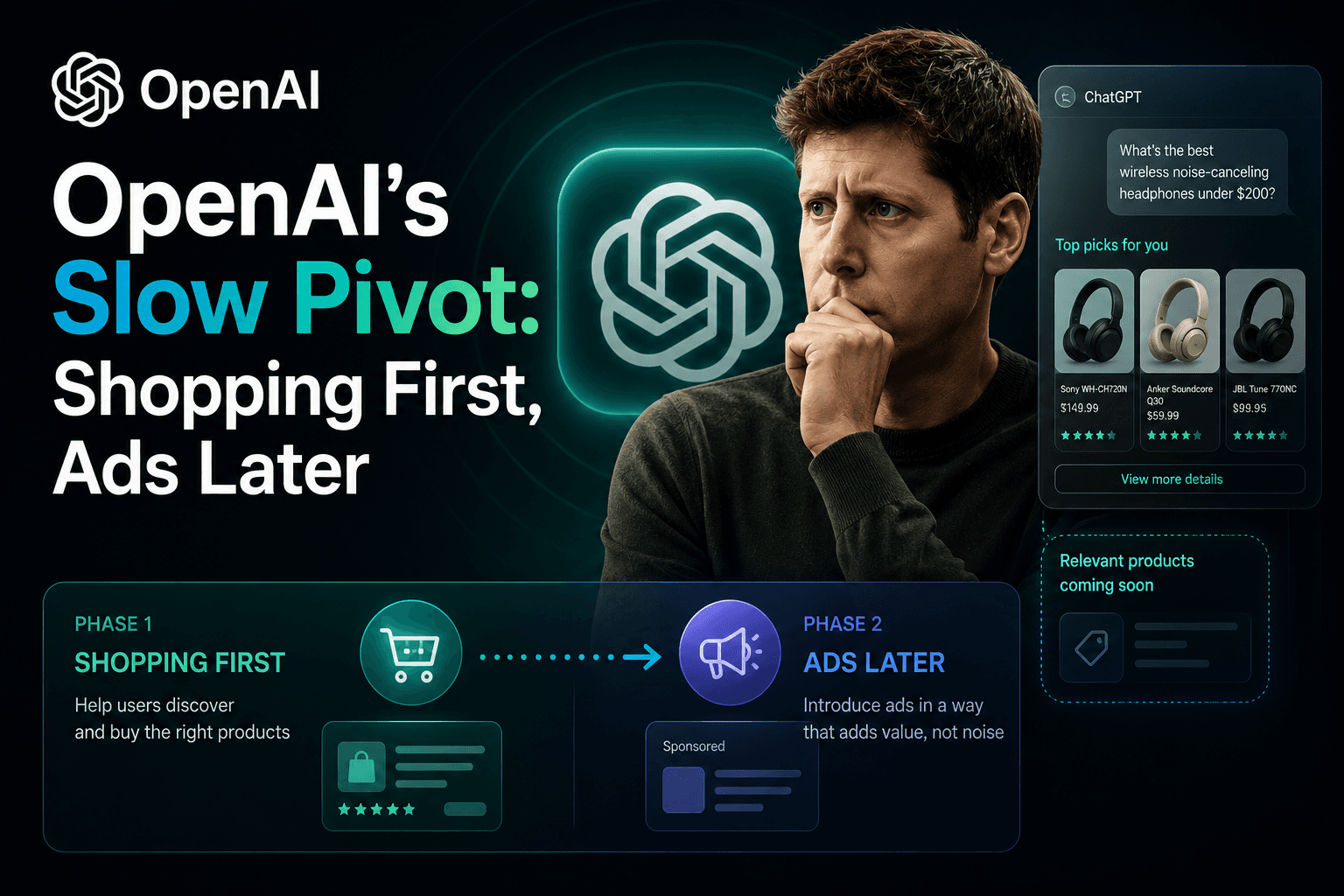
OpenAI's Slow Pivot: Shopping First, Ads Later
OpenAI's actual moves through 2025 and into 2026 have been deliberately cautious — and notably, structurally different from what its competitors built.
Rather than starting with conventional sponsored ads, OpenAI launched:
Instant Checkout (September 2025) — partnerships with Etsy and Shopify enabling transactions inside ChatGPT, expanded to Walmart in October 2025.
Shopping Research — a feature that lets users compare products, generate gift recommendations, and find lookalike alternatives. Available to free, Go, Plus, and Pro tiers (OpenAI) (Retail Dive).
"Intent-based monetization" — an internal framing for how ChatGPT may eventually recommend specific products without compromising answer integrity. Reported December 2025 reporting indicates OpenAI is exploring sponsored content models, sponsored GPTs in the GPT store, and affiliate-style commerce links (SiliconANGLE).
Altman has been explicit that modifying model output in exchange for payment "would feel really bad," and the company has consistently floated affiliate or transaction-based models rather than impression-based ads. Financial pressure is real: as of October 2025, only ~5% of ChatGPT's weekly active users subscribed to paid plans, and OpenAI projected average revenue per non-paying user from monetization would reach roughly $2 annually next year and $15 by decade's end.
What this means in practice: OpenAI is approaching the ad market backwards relative to Google and X. Where competitors are building large-scale paid distribution surfaces, OpenAI is building a transactional commerce layer first, and treating "ads" as a downstream possibility — not the foundation.
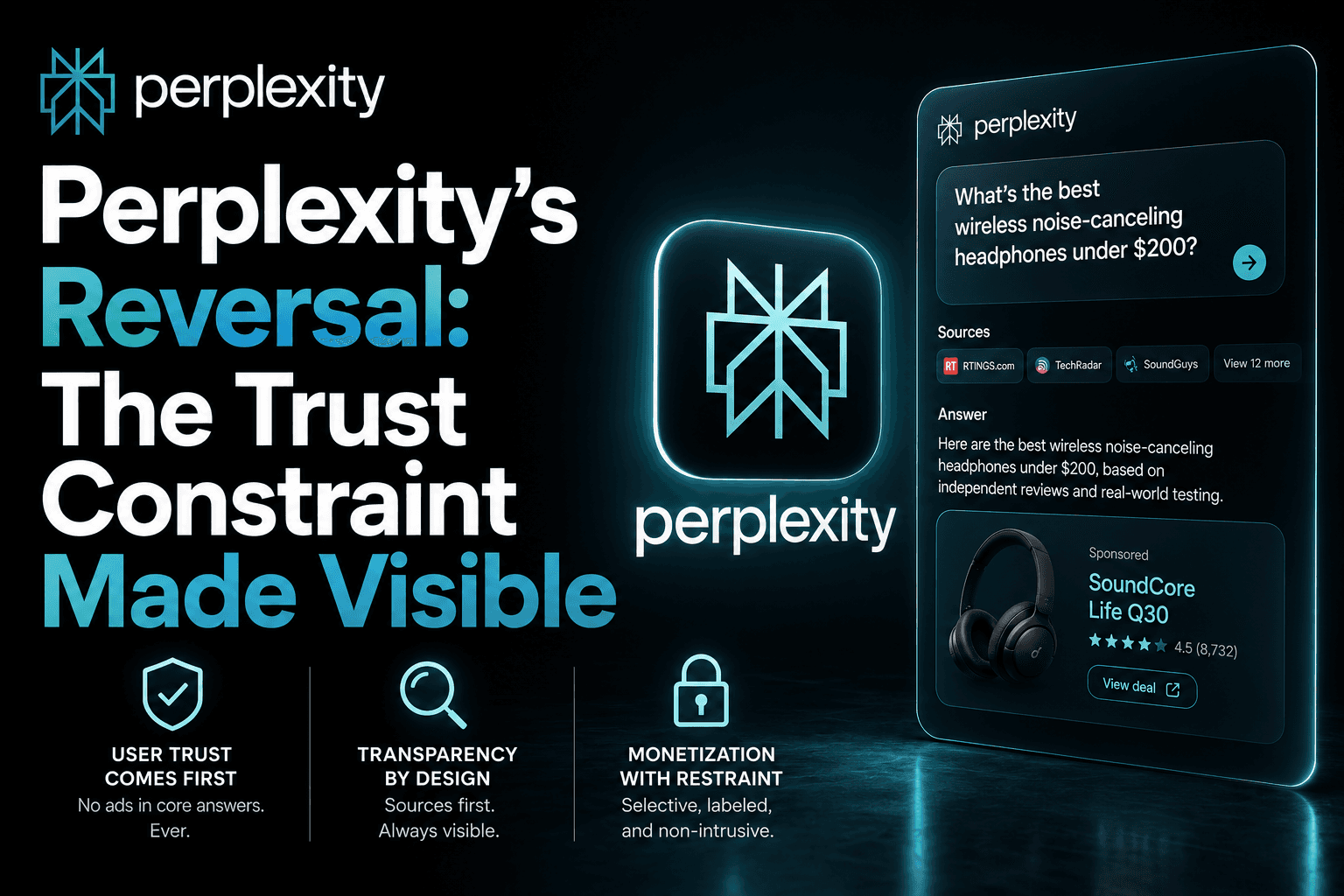
Perplexity's Reversal: The Trust Constraint Made Visible
The clearest cautionary tale in this market is Perplexity AI, which launched sponsored follow-up questions in November 2024 with brands including Whole Foods Market, Universal McCann, and PMG. The platform anticipated CPM rates exceeding $50 with minimum guarantees for category exclusivity across 15 key sectors (Search Engine Land).
By February 2026, Perplexity had reversed course. The company paused new advertisers, removed sponsored content, lost its ads lead, and publicly pivoted toward subscriptions and business sales (MacRumors).
The stated reason was user trust: in an answer-engine context, users may distrust responses that appear to be ad-influenced — and that distrust threatens the core product. Perplexity's exit reframes the conversational ad market into two camps: companies whose primary product is a question-answering engine (Perplexity, ChatGPT) where ads are existentially risky, and companies whose primary product is a distribution channel (Google Search, X feed, Bing) where ads are the business model.
This explains, more than any internal OpenAI memo, why Altman has moved slowly.
What This Means for Marketers in 2026
Three structural shifts are now consensus among practitioners watching this market:
1. Paid-media planning has fragmented across four AI ecosystems. A complete 2026 brief now considers Google AI Overviews/AI Mode, X with Grok-powered semantic targeting, Microsoft Copilot Commerce, and — eventually — OpenAI's commerce layer. Each uses different signals, different reporting, and different attribution windows.
2. Targeting language is shifting from demographics to intent and context. X's semantic targeting and Google's conversational discovery ads both bypass the old "audience-as-segment" model in favor of matching ads to the contextual moment. Briefs written in 2018 categories — age, income, broad interest — increasingly underperform briefs written in intent moments and topic clusters.
3. Content strategy is the new SEO. As traditional search rankings lose visibility to AI-generated answers, the asset that matters is no longer the page that ranks but the content that AI assistants cite. This has been called Answer Engine Optimization (AEO), but the practical implication is that brands need to publish answer-shaped content — structured, factual, and clearly attributable — to maintain organic presence inside AI Overviews, Copilot responses, and ChatGPT citations.
For marketing teams operating in regional markets — the Kansas City mid-market, for example — the immediate decision isn't which platform to bet on, but which two to instrument first. A practical 2026 baseline: instrument Google AI Mode performance through Google Ads' new AI placements, run a small X semantic-targeting test, and treat ChatGPT/Claude as an organic AEO surface rather than a paid one until OpenAI's monetization design clarifies.
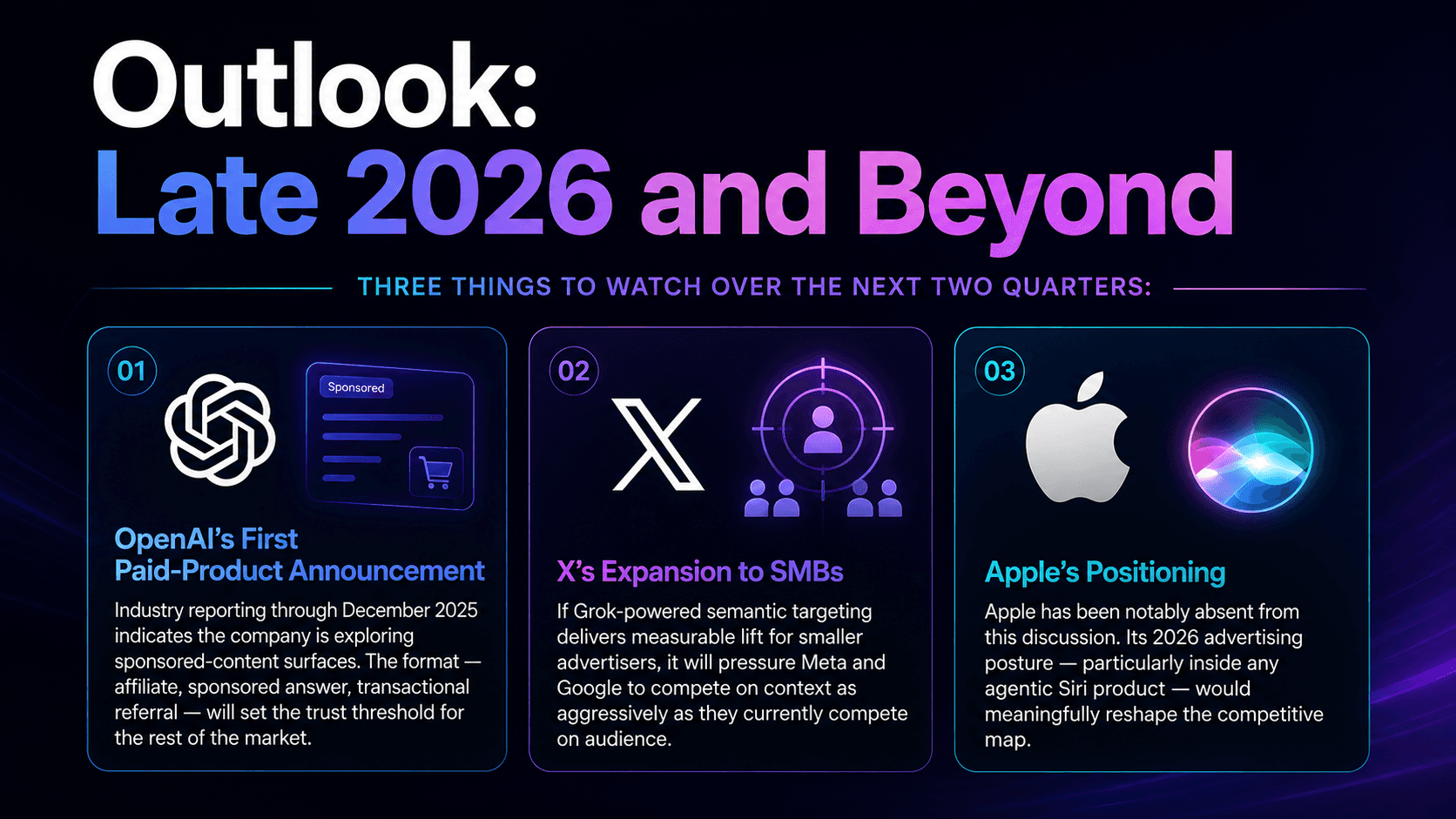
Outlook: Late 2026 and Beyond
Three things to watch over the next two quarters:
OpenAI's first paid-product announcement. Industry reporting through December 2025 indicates the company is exploring sponsored-content surfaces. The format — affiliate, sponsored answer, transactional referral — will set the trust threshold for the rest of the market.
X's expansion to SMBs. If Grok-powered semantic targeting delivers measurable lift for smaller advertisers, it will pressure Meta and Google to compete on context as aggressively as they currently compete on audience.
Apple's positioning. Apple has been notably absent from this discussion. Its 2026 advertising posture — particularly inside any agentic Siri product — would meaningfully reshape the competitive map.
The category OpenAI was expected to define is now a four-player race, with the original favorite running fourth on purpose. Whether that caution becomes a long-term moat or a strategic mistake will be one of the defining business stories of the next 18 months.
Sources
PC Gamer — Sam Altman's "last resort" stance and shift toward ChatGPT ads
SiliconANGLE — OpenAI explores conversational ads, "intent-based monetization"
Google Blog — A new generation of ads for the AI era of Search
Social Media Today — Elon Musk on the future of X ads and Grok integration
Marketing Agent Blog — Microsoft Copilot Commerce, April 2026 updates
Search Engine Land — Perplexity begins testing sponsored questions
MacRumors — Perplexity abandons AI advertising, February 2026
PROJECT


