BLOGS
Google Says AI Content Needs a Human Editor — Including Your Title Tag


Ben Ahn
Linkplus, Director
Quick answer: On October 1, 2026, Google updated its generative AI content guidance to say every AI-generated page must be manually fact-checked and reviewed by a person before publishing. The rule covers more than body text: title tags, meta descriptions, structured data, and image alt text are all included. The fix is an editor with authority, not a better prompt.
Key takeaways
Google does not penalize AI content for being AI-made; it penalizes unreviewed or valueless content at scale.
Review now explicitly covers title, meta description, schema, and alt text.
Structured data must follow Google's guidelines and pass validation.
Google makes no promise that fixing content restores lost traffic.
One named editor with the power to approve, fix, or kill a page is the minimum.
What did Google change in its AI content guidelines on October 1, 2026?
Google now requires a manual fact-check and review of all AI-generated content before publishing, and it extended that requirement to page metadata. The update appears in Google Search Central's guidance on using generative AI content.
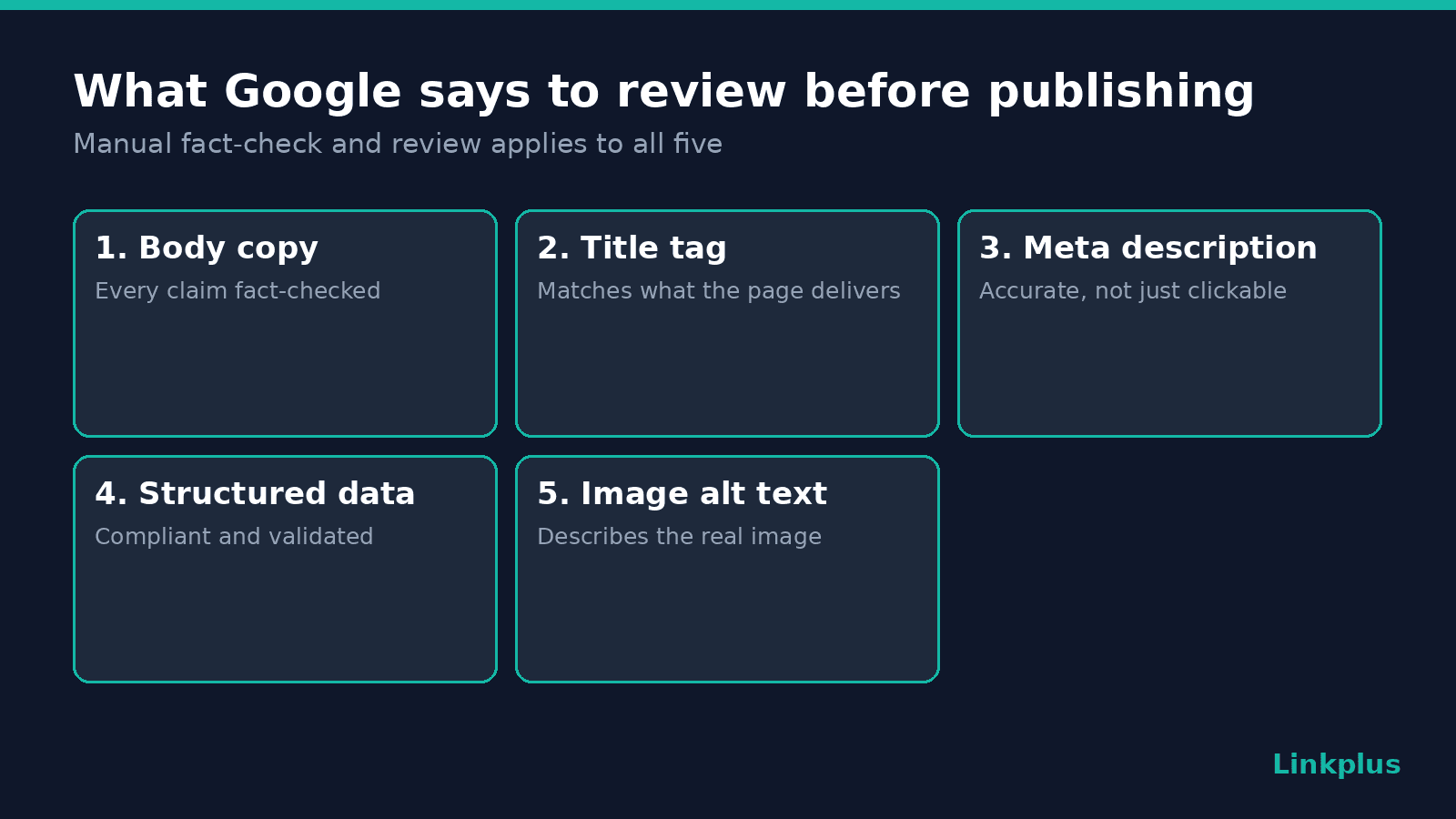
The same paragraph names four elements that can appear in Search results and therefore need the same review: <title> elements, meta descriptions, structured data, and image alt text. For structured data, Google adds a second step: follow its structured data guidelines and validate the markup.
Google's reasoning is short. Generative models predict likely word sequences rather than retrieving facts, so their output can contain errors. The guidance also points to Google's spam policy on scaled content abuse: producing many pages primarily to manipulate rankings, without adding value for users.
Definition: Scaled content abuse is Google's spam policy against generating large volumes of pages, by any method, that add little or no value for users.
Why is this a content-operations problem, not an SEO checklist?
Because the fix is a person with authority, not a better prompt. MarTech's October 13 analysis argues that each piece needs a real editor who has enough context, access, and authority to improve the work or kill it.
If your workflow generates hundreds of articles and gives each one a quick skim, a sharper prompt won't close the gap. The gap is editorial capacity: someone has to own every page.
Will fixing AI content bring traffic back?
Not necessarily, and Google doesn't promise it. According to MarTech, Google says improvements can take time to register in Search and may not produce a noticeable change. A page can get better without recovering its clicks, so treat review as a quality floor, not a traffic strategy.
What should Kansas City business owners do this week? A 6-step AI content review checklist
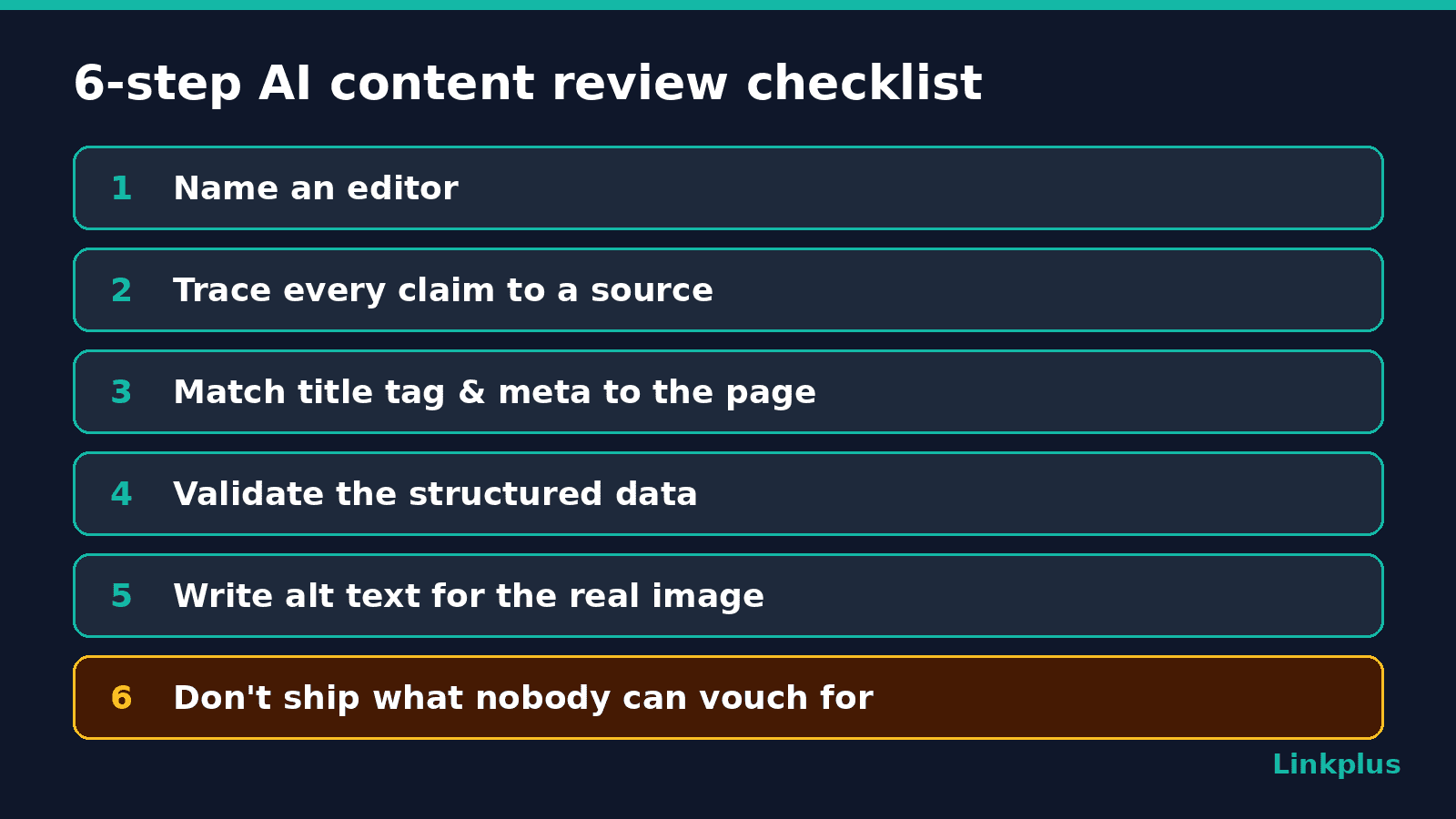
Name one editor, give them final say over everything AI touches, and run every AI-assisted page through these six checks before it goes live.
Name an editor. One person who can approve, fix, or kill a page. Not a rubber stamp.
Trace every claim to a source. Numbers, dates, prices, and quotes need a link someone on your team actually opened.
Match the title tag and meta description to the page. If the snippet promises something the page doesn't deliver, rewrite the snippet.
Validate the structured data. AI-scaffolded schema still has to follow Google's guidelines and pass Google's Rich Results Test.
Write alt text that describes the real image. What is in the picture, not a keyword string.
Don't ship what nobody can vouch for. If no one will put their name behind a page, it waits.
How does Linkplus run human review on AI content in Kansas City?
AI does the volume; a named human owns the sign-off. That has been the Linkplus model since before this update, and Google's guidance now reads like a description of it.
Research — AI: Source pulls, summaries. Person: Opening every source and confirming the claim.
Draft — AI: First draft. Person: Edits for accuracy, voice, and local context.
Metadata — AI: Title and meta description suggestions. Person: Checking them against what the page delivers.
Schema — AI: JSON-LD scaffolding. Person: Validation in Google's Rich Results Test.
Images — AI: Alt text draft. Person: Rewriting alt text to describe the real image.
Publish — AI: —. Person: The final yes or no.
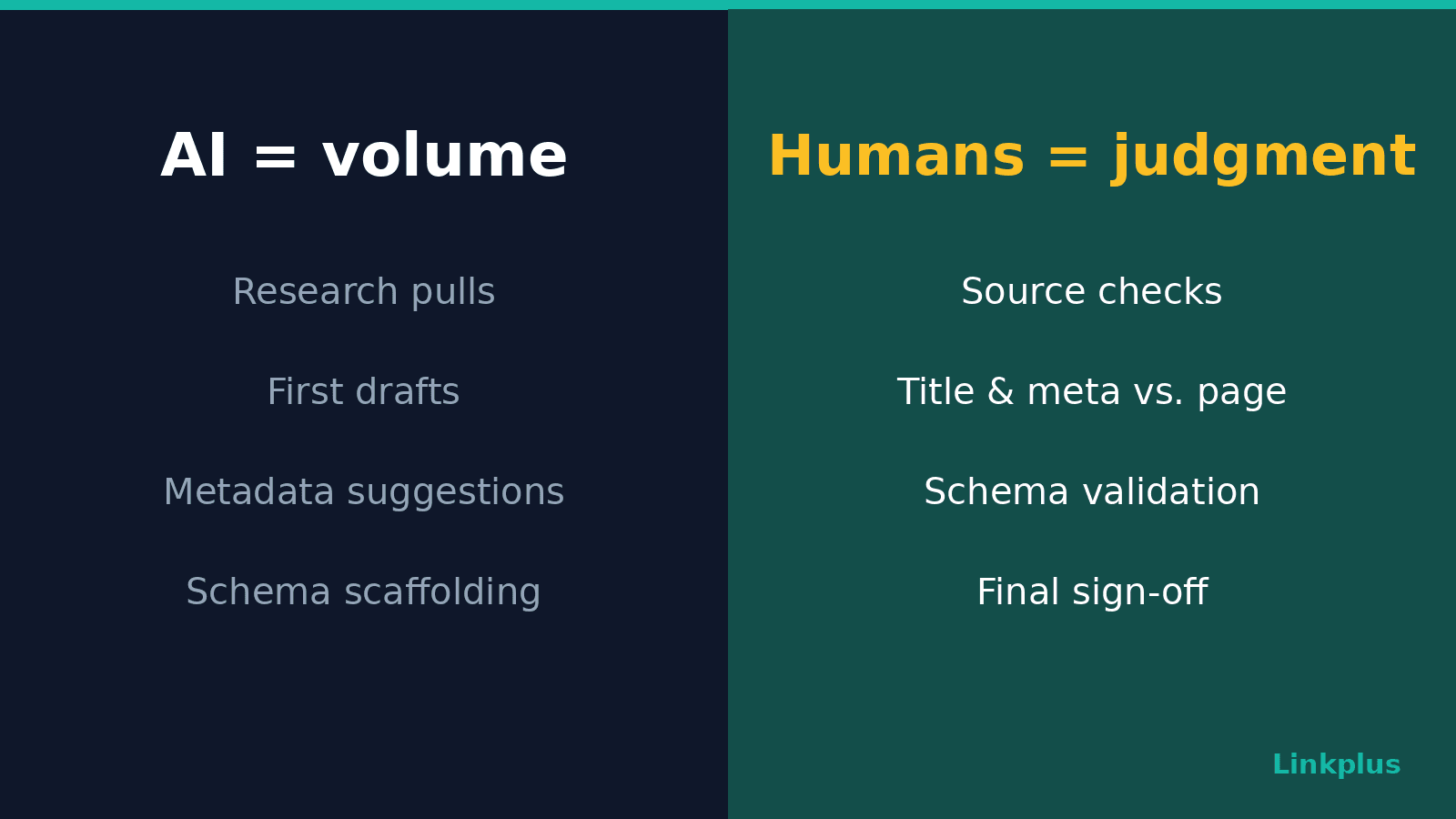
AI = volume. Humans = judgment. Google just made that the standard, not a slogan.
Want a second set of eyes on your AI content? Linkplus runs a free AI content review for Kansas City businesses: we check your last five AI-assisted pages against the six steps above. Book a 20-minute review →
About the author — Ben Ahn is the founder of Linkplus Marketing & Media Agency, a bilingual (Korean/English) AI marketing agency in Kansas City. He advises TheKey Inc. on US market and AI business development and leads the Kansas City Korean Business Network.
FAQ: Google's AI content guidelines
Does Google penalize AI-generated content in 2026?
No, not for being AI-generated. Google's guidance targets AI content that is published without review, or produced at scale without adding value for users. That second case can violate Google's spam policy on scaled content abuse.
Do I need to review title tags, meta descriptions, and alt text written by AI?
Yes. Google's October 2026 guidance names title elements, meta descriptions, structured data, and image alt text directly, because each of them can appear in Search results.
Does AI-generated structured data need validation?
Yes. Google says structured data must follow its structured data guidelines and be validated. Use Google's Rich Results Test or Schema Markup Validator before publishing.
If I fix my AI content, will my traffic come back?
Maybe, but Google does not promise it. Google says changes can take time to register and may not produce a noticeable improvement, and better rankings don't guarantee the same number of clicks.
Who should review AI content at a small business?
One person who knows the business and has the authority to change or stop a page before it goes live. The review needs context and decision power, not a quick skim.
What is scaled content abuse?
Scaled content abuse is Google's spam policy against generating many pages, by any method including AI, that add little or no value for users. It applies whether the pages are made by AI, by humans, or by a mix of both.
Sources
Google Search Central — Google Search's guidance on using generative AI content on your website
MarTech — Google changed its content guidance. Don't expect a reset. (Oct. 13, 2026)
PROJECT