BLOGS
Three Models in Three Days. Then How We Actually Work.


Ben Ahn
Linkplus, Director
What shipped in the first week of September 2026?
Three frontier models landed in three days, and the industry pitch shifted from better copy to agentic work. The desk upgraded from assistant to workbench.
This is how our desk is seated this month — not a forever ranking of models.
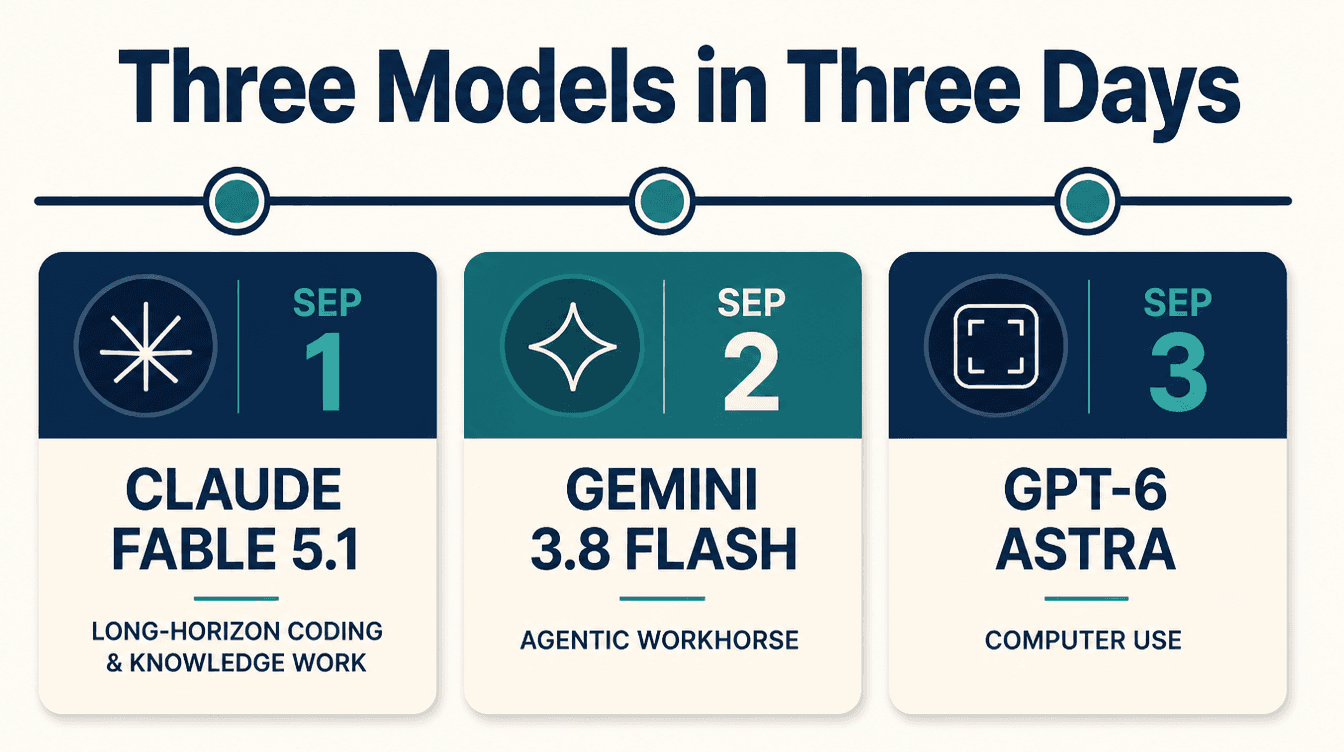
Sep 1 — Claude Fable 5.1 (Anthropic). Long-horizon coding and knowledge work: multi-step research, docs, spreadsheets, slides, and plans that stay coherent over hours.
Sep 2 — Gemini 3.8 Flash (Google). Agentic workhorse at Flash price — speed and cost for volume drafts, prototyping, and Google-adjacent SEO/AEO workflows.
~Sep 3 — GPT-6 Astra (OpenAI). Computer use across browser, CRM/forms, docs, and decks — execute the brief on a real desktop, not just describe the next step.

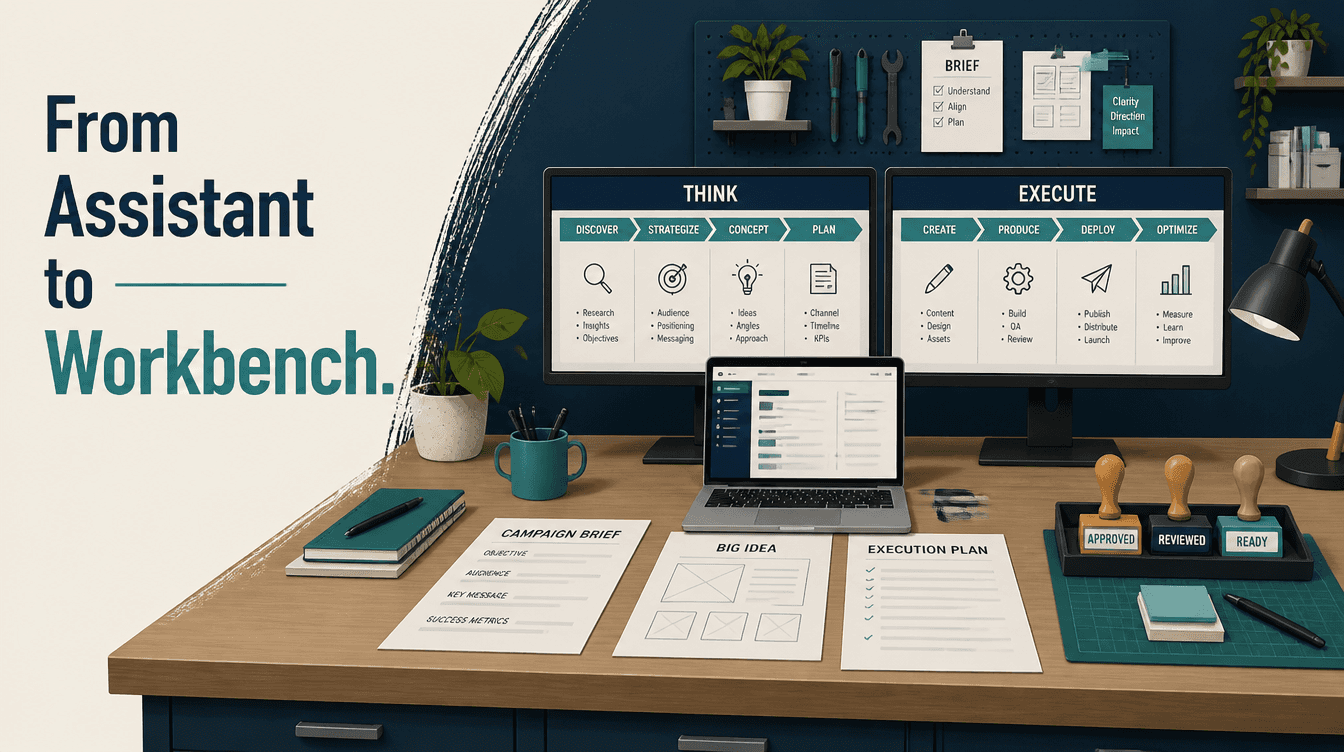
Official blogs push agentic capability. Practitioner chatter on X splits the lane differently: Astra for workflows and enterprise computer use; Fable for long plans and orchestration (writing takes are mixed); Gemini for speed, cost, and fast prototyping. The shared story is the same: marketing no longer needs a chatbot that writes captions. It needs a workbench that thinks, executes, and ships under human gates.
What does each release change in practical marketing terms?
Claude is the thinking seat, GPT Astra is the execute seat, and Gemini is the Google-adjacent volume and SEO/AEO seat — and approval gates matter more than ever.

Claude (thinking seat). Use it when the brief is ambiguous, the audience is mixed, or the strategy still needs a long plan: positioning, offer logic, research synthesis, campaign architecture, and “what would we regret shipping.”
GPT Astra (execute seat). Use it when the decision is clear and the work is operational: fill the form, update the CRM, assemble the deck, cut the variants, push the checklist across browser tabs. Computer use turns execution into a seat, not a prompt.
Gemini (Google-adjacent volume / SEO–AEO seat). If Google Search or AEO touches revenue, you need a measurement seat next to Search — for us that seat is often Gemini: volume drafts, structured answers, SERP/AEO experiments, and cost-efficient iteration.
The practical change is not “pick a winner.” It is seat assignment plus human sign-off. Faster agents without gates just ship faster mistakes.
How am I using these models day to day?
I already run Claude and GPT together every day — think with Claude, execute with GPT, and keep a Google SEO/AEO seat in the room — for us, often Gemini. The scarce resource is not tokens. It is marketer judgment plus which model executes.
A typical Linkplus day looks like this: Claude holds the thinking pass (audience, offer, risk, “what does good look like”). GPT Astra takes the execute brief once the decision is written. Gemini handles Google-adjacent volume — outlines for AEO, Search-shaped FAQ blocks, and cheap iteration when we need many variants near Google surfaces. I do not ask one model to be the whole agency.
What is the dual brain — and why does Linkplus bet on it?
The dual brain is human judgment plus the AI that executes best for each seat. AI supplies volume. Humans supply judgment. Linkplus runs that dual brain for Kansas City brands.

One brain decides what matters — brand voice, compliance, audience dignity, whether the offer is true. The other brain executes at machine speed — drafts, variants, browser steps, SEO/AEO packaging. Betting on a single “best model” is a product demo. Betting on seats and gates is how a local agency ships work clients can trust.
What should Kansas City brands do with this news?
Do five steps: write the decision, run a thinking pass in Claude, hand an execute brief to GPT or Gemini, require human sign-off, then score rework.

Write the decision. One paragraph: audience, offer, constraint, success metric. No model starts until this exists.
Thinking pass (Claude). Ask for risks, alternatives, and a short plan — not final copy.
Execute brief (GPT or Gemini). GPT Astra for computer-use workflows and decks/CRM; Gemini for Google SEO/AEO volume and fast variants.
Human sign-off. A person owns brand, claims, and “would we put our name on this.”
Score rework. Track what came back for edits. That score tells you which seat is weak — not which press release to believe.
If you sell in the KC metro, this week is for rewriting the workbench, not for buying another generic “AI content” package.
If you want a second set of eyes, we can sit your current stack next to these seats and show what still makes sense for a Kansas City brand.
Frequently asked questions
Is Claude smarter than GPT?
Wrong question for marketing ops. Claude is stronger as our thinking seat for long plans and judgment scaffolding. GPT Astra is stronger as our execute seat for computer use and shipping the brief. Pick seats, not a trophy.
Can I skip Gemini?
You can skip it for some workflows — not when Google Search or AEO touches revenue. Then you need a measurement seat next to Search; for us that seat is often Gemini: speed, cost, and Search-shaped iteration.
Biggest risk?
Letting agentic speed skip human gates. Three models in three days made execution cheaper. They did not make brand judgment optional. Unapproved CRM edits, thin SEO pages, and confident wrong claims ship faster than ever.
Sources
Anthropic — Introducing Claude Fable 5.1
Practitioner coverage / X discussion note — Engadget on Astra computer-use reaction (workflows/enterprise vs long-plan/orchestration vs speed-cost split across practitioner posts)
PROJECT


